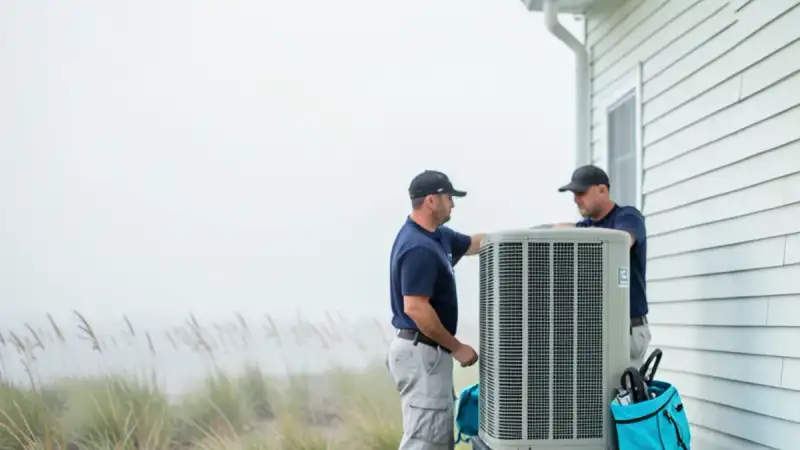
Salt Air and Your AC: How Long Units Last on the Coast
No one publishes a Charleston number, so here is what the sources actually say and what to look for on your own unit.
- 4.9★ on Google (16 reviews)
- Open 24 hours, 7 days
- Clear, upfront quotes
By the Aero Air Techs team. Published October 30, 2026, updated October 31, 2026.
There is no official figure for salt air AC lifespan in Charleston. We looked for a government or university study that measures AC life by distance from this coast and did not find one. What exists is a general average from a manufacturer and a few lower estimates from an industry site.
Carrier also says salt spray corrodes the condenser coil faster than inland air, and that much is not in doubt.
So be careful with any single number, including one a salesperson gives you. Your unit's real life comes down to how close it sits to salt water, how it was built and whether anyone rinses and services it.
What does the salt air AC lifespan data say for Charleston?
They say less than you would hope. Here is everything we could trace to a named source.
| Source | Range | What it covers | How to read it |
|---|---|---|---|
| Carrier consumer guide | 15 to 20 years | Central air conditioners on average | A general average, not a coastal figure |
| HVAC.com, June 2025 | Closer to 10 to 15 years | South Carolina overall | Blames heat, humidity and ocean air. No study cited |
| HVAC.com, June 2025 | As low as 5 to 8 years | Standard units in coastal areas | Written as a worst case. No study cited |
| HVAC.com, June 2025 | 10 to 15 years | Salt-resistant coastal models with regular maintenance | No study cited |
Use the table for direction only. The pattern is believable, because salt does shorten the life of outdoor metal. The exact numbers are estimates, and none of them was measured on a Charleston street.
What does salt attack on an AC unit?
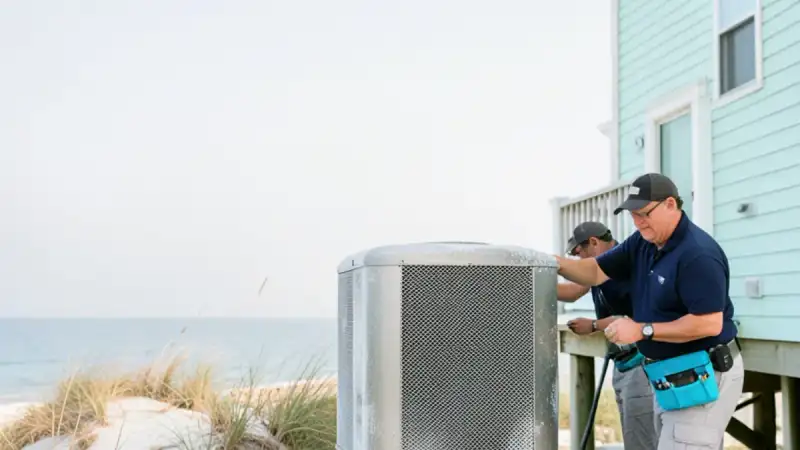
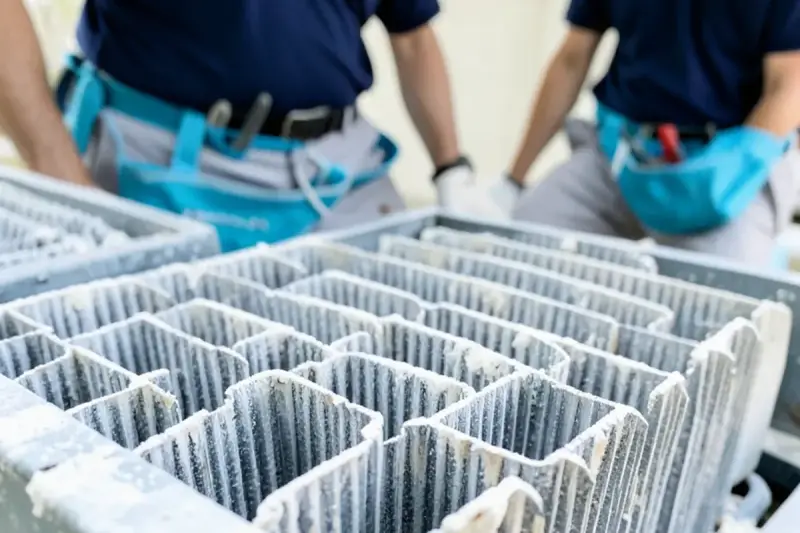
Salt goes after the metal outside, and the condenser coil goes first. Carrier names the coil as the part saltwater spray corrodes faster than inland air, and that fits how the unit is built. The fins are thin aluminum, and the coil pulls a huge volume of outdoor air straight through them every hour it runs.
Salt on those fins grabs moisture from the air and keeps the metal wet. Once fins flake away, the coil sheds heat poorly. The compressor then works harder and the unit runs longer to do the same job.
The coil is not alone. These parts also suffer:
- Electrical connections. Contactor and capacitor terminals can corrode, which leads to hard starts and failed parts.
- Cabinet and fasteners. Screws and panels rust, and a loose panel rattles and lets more weather in.
- Base pan. Water and salt sit at the bottom of the cabinet.
- Copper joints. Corrosion at the coil can end in a slow refrigerant leak.
How does Goose Creek compare with the islands?
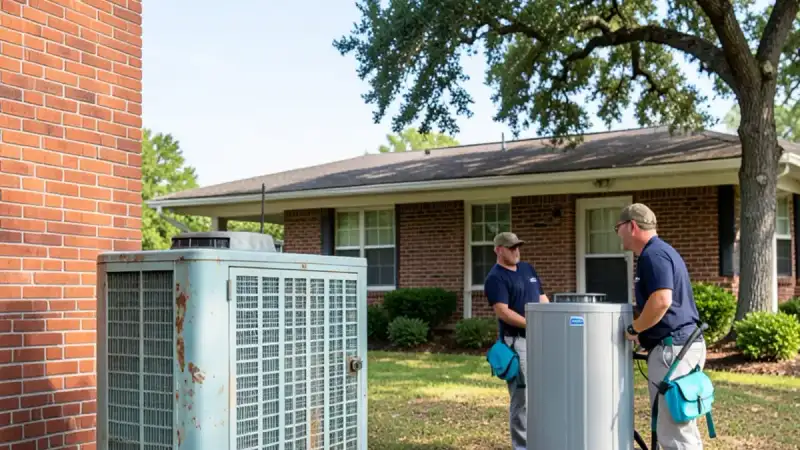
Goose Creek sits inland in Berkeley County, so a condenser there is not taking the direct spray a Folly Beach unit takes. That difference is real, and you should weigh it before you pay extra for coastal equipment on an inland lot.
Inland does not mean untouched. HVAC.com says salt can damage outdoor units several miles from the ocean, though it gives no distance and no data. We are not going to invent a mileage line either. Look at your own coil.
Heat is the bigger force in an inland yard. NOAA normals for Charleston International Airport show 64.3 days a year at or above 90°F. Those days mean long run hours, and run hours wear a unit out whether it sees salt or not. Grass clippings and pollen packed into the coil do the rest.
Which signs show a coastal unit aging early?
Walk around your outdoor unit with the power on and your hands off it. You are looking for these:
- White or green crust on the fins or copper
- Fins that flake away when a hose hits them
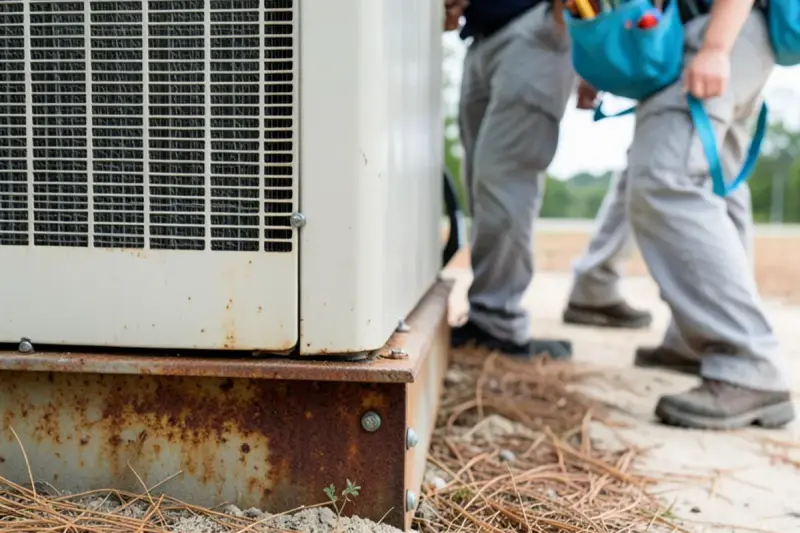
- Rust on the base pan, the lower panels or the cabinet screws
- Longer run times than last summer on similar days
- The same small electrical part failing more than once
- Oily patches on the coil, which can point to a refrigerant leak
One of these signs is a reason to get a coil check. Several together are a reason to start thinking about what comes next.
What gives a unit near salt water more years?
Nothing makes a coil immune, but these habits are worth doing.
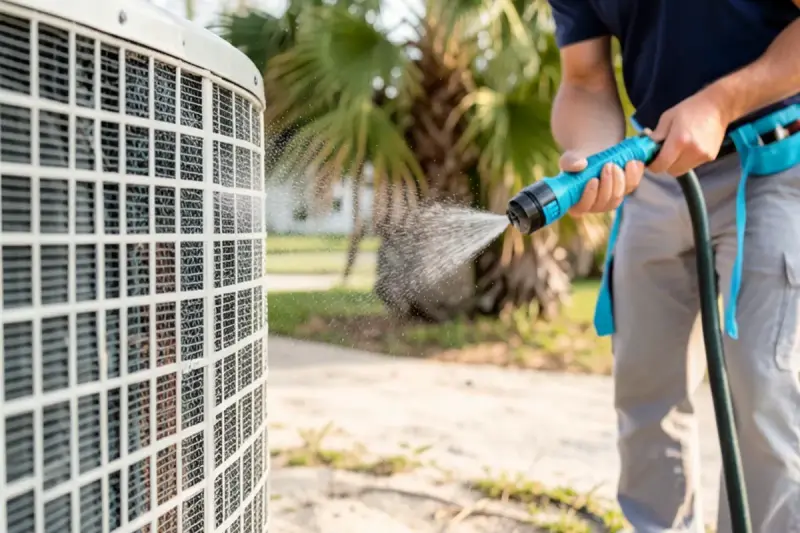
- Rinse it. Fresh water, gentle pressure, power off. Our coastal AC repair page has a suggested rinse schedule by location.
- Buy for the location. Carrier advises coastal homeowners to look for units built for salty air. Ask each bidder what is actually different: coil, coating, fasteners or cabinet.
- Think about placement. A spot sheltered from the direct onshore wind helps, as long as the unit keeps open airflow on every side.
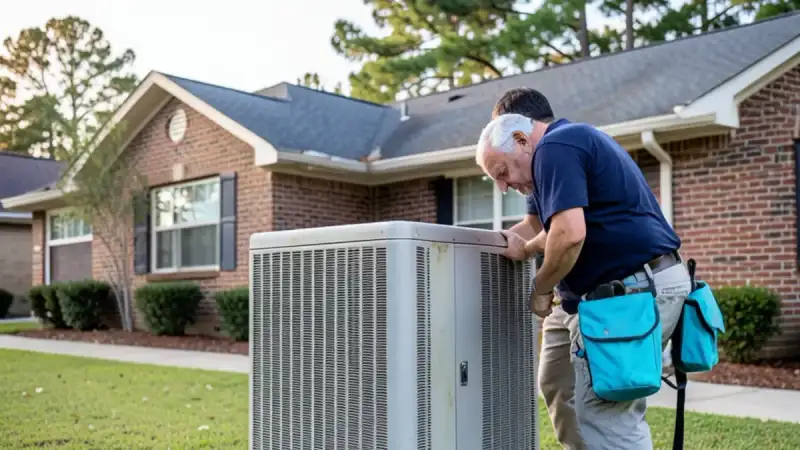
- Keep up yearly service. ENERGY STAR recommends a pre-season contractor check of cooling in spring. A yearly AC tune-up is when small corrosion gets caught.
- Read the warranty terms. Ask the manufacturer whether a coastal install changes the coverage, and how close to salt water that applies.
What can coil coatings really do?
Coatings buy time, and they do not stop corrosion. A factory or field coating puts a barrier between the salt film and the aluminum fins, so the metal takes longer to pit. It only works if it covers the fins evenly, which is why a coating applied at the factory is usually easier to trust.
Ask these questions before you pay for one.
- Is it factory-applied or sprayed on site? A site coating needs a very clean coil to bond.
- Does it change the warranty? Some makers have terms on coatings, so ask first.
- Does it affect the rating? A thick coating can reduce heat transfer a little.
- What maintenance does it need? Rinsing still matters, since salt builds on a coated fin too.
- What about the rest of the unit? Fasteners, cabinet panels and electrical parts all stay exposed.
How close to the water counts as coastal?
There is no official line, and no agency publishes one. Wind direction, buildings and trees all affect how much salt reaches a condenser, so two homes on one street can differ.
Use your own unit as the guide. Look for white or green crust on the fins, rust at the base pan and pitted screw heads. A unit a mile inland with a clean coil needs less attention than one a block from the marsh, however the map looks. Check it after each large storm too, because onshore wind can carry salt farther than usual.
If you are buying a house near the water, ask for the install date and any rinse or service records, then look at the coil yourself. Two units of the same age can be years apart in condition.
What should you do with a new unit in its first year?
Start the record on day one. Take dated photos of the coil, cabinet and fasteners while everything is clean, since they make later changes easy to see.
- Rinse on a schedule. Set a calendar reminder that suits how close you are to salt water.
- Keep the base clear. Sand, leaves and mulch hold moisture against the cabinet.
- Check the fasteners. Ask the installer to use corrosion-resistant hardware, and have it inspected yearly.
- Book the first service visit. An opened panel shows you how the contacts are holding up after one season.
How we judge a rusty outdoor unit
Do not replace a unit because a number on the internet says it should be dead. Do not keep paying for repairs on a coil that is coming apart, either.
We start with the coil, then the electrical parts, then the repair history. If the fins are solid and the fault is a burned contactor, repair it and move on. If the coil is leaking and the fins crumble, a patch rarely holds for long, and refrigerant keeps going out the same way.
Age is one input, not the verdict. A clean older unit can be a better bet than a younger one sitting in the spray. When the numbers get close, our guide on when an old AC is not worth fixing walks through the decision.
Aero Air Techs is based in Charleston and serves the surrounding areas, from the islands to Goose Creek. Call with what you see on the coil. You get a clear, upfront quote before work begins, and if AC replacement is the right call, ask us to show you why on the unit itself.
Related questions
Does rinsing an AC unit with fresh water help near the coast?
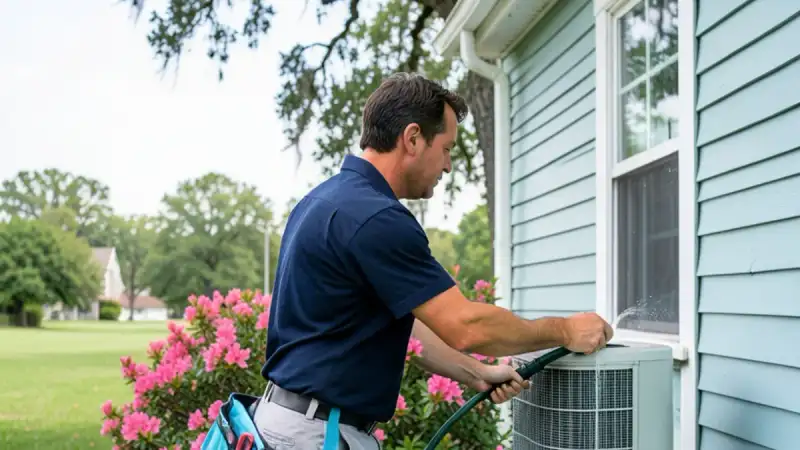
Yes, it is the simple habit most worth keeping. Fresh water carries salt off the coil before it sits there holding moisture. Turn the power off at the disconnect first, use a garden hose on a gentle setting and let the unit dry. No agency publishes a rinse schedule, so let the look of your fins set how often.
How far inland does salt air reach?
There is no measured cutoff that we could find for the Charleston area. HVAC.com says salt can affect outdoor units several miles inland, without giving a distance or a study. Wind, tides and what stands between your unit and the water all matter, so a Goose Creek homeowner should look at the coil, not a map.
Will a coated coil make my AC last longer?
A coating is meant to slow corrosion, but no source we found gives a reliable figure for how many years it adds. Ask any bidder what is coated, when the coating is applied and whether it changes the manufacturer's coverage. Compare that answer with what your location really needs before you pay for it.